
Generalities
“Life-cycle assessment (LCA) is a process of evaluating the effects that a product has on the environment over the entire period of its life thereby increasing resource-use efficiency and decreasing liabilities.” (European Environment Agency *https://www.eea.europa.eu/help/glossary/eea-glossary/life-cycle-assessment*)
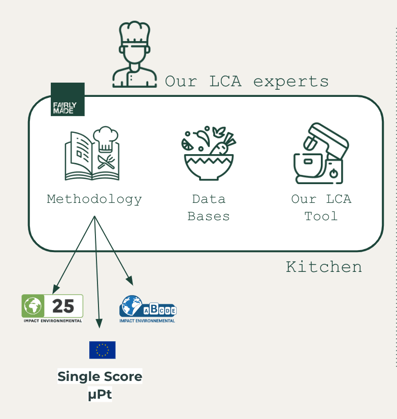
LCA is an analysis methodology that can be understood as an “Environmental accounting method for the life cycle of a product or system”, or as a cuisine allegory :
To make an LCA you need a methodology, databases & LCA tool.
- The Methodology (PEFCR for example) will explain you how to pick the different ingredients, it is the recipe book.
- The databases is your fridge, it has many ingredients into it. One ingredient is an "impact factor". A Database has thousands of it. For example "How many CO2 does the production of 1kg of cotton, in australia, produce?"
- The LCA tool is your robot that will help you mix all these ingredients coming from database & ingredients coming from your systems more easily.
The results you get, are the 16 Criterias of impact (including the CO2 for example)
All good? Let's move on

This particular method is characterized by two major properties :
- Multi-step : the analysis takes into account a multiplicity of steps from the product’s lifecycle
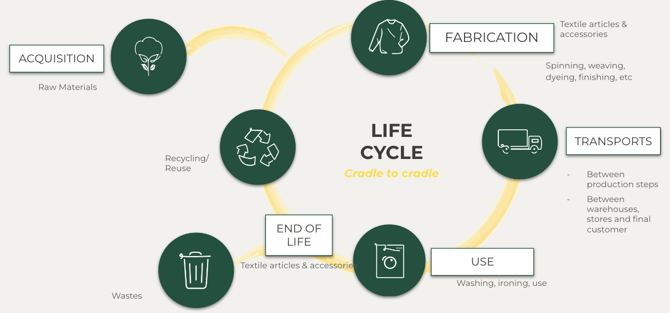
- Multi-criteria : the analysis results are expressed in a multiplicity of impact factors (contrary to a carbon footprint that only focuses on GHG emissions)

Methodological Frame
LCA is defined by the norms ISO 14040-14044 describing the barebone structure and frame to respect when conducting a Life Cycle Assessement : specifically 4 main steps
- Scope & Goal Definition ⇒ Where you define what is the system/product under study, and the goal of the analysis.
- Life Cycle Inventory ⇒ Where you indicate all the data you will be using for the analysis. These data can come from your knowledge of the system, direct measures from the field or proxies from relevant databases.
- Evaluation of Environmental Impacts ⇒ Where you compute the long list of life cycle inventory results into a limited number of indicators.
- Results Interpretation ⇒ Where you take a step back on the analysis and gather insights, often in the context of an ecodesign approach.

Scope & Goal Definition
A necessary step to clearly define what is analyzed and what is not within the scope of the analysis.
There are 4 key elements to know when considering this step :
- FUNCTIONAL UNIT Unit on which is based the assessment Defined by a functional criteria, a quality criteria and a temporal aspect. Ex : “Covering a m2 wall evenly for 20 years”
- REFERENTIAL FLOW The quantity of product required to provide for one Functional Unit
- SYSTEM SCOPE Define the assumptions and steps & elements taken into account in the modelling. ⇒ Cradle to Gate VS Cradle to Cradle ⇒ Plant installation and maintenance, transport, heating and food for employees, etc…
- CUT OFF RULE Definition of negligible elements ex : All components up to a total of 5% of product weight can be ignored.
Lifecycle Inventory
The longest and most tedious stage of LCA in general.
This involves gathering the data needed to model the system or product under study

These data can be primary or secondary, either coming from your own measures and knowledge or from literature and public or private databases.
Evaluation of environmental impacts
Use calculation methods to express all the inputs and outputs of the system in environmental impacts.
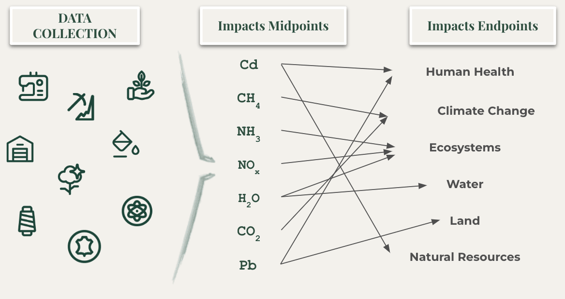
Calculation methods are the rules that transforms all the inputs of a model into aggregated environmental impacts :
-
midpoints impacts : expressed in a chemical equivalent, represents the change in the environment caused by emissions or ressource use.
Ex : a quantity of methane (CH4) into a quantity of carbon dioxyde (CO2) equivalent to represent global warming potential
-
endpoint impacts : which are representing damages or benefits on specific aspects of the environment like human health or biodiversity.
Results interpretation
The final step of the analysis is to extract key knowledge from the analysis, often in the context in an ecodesign. Usually this is carried through the following approaches :
- Life Cycle hotspots identification
- Compare Life Cycle scenarios for a product
- Compare different products with the same function