
The nature and quantity of an elementary flow will have a direct effect on one or more impact criteria.
Example : CO2 and methane (CH4) are elementary flows that can be emitted during the life cycle of a product. They are both greenhouse gases and therefore have a direct effect on the ‘Climate Change’ impact expressed in kg CO2 equivalent.
There are two types of impact categories:
- Impact Midpoint: Impact categories at problem level.
- Impact Endpoint : Impact categories at damage level.
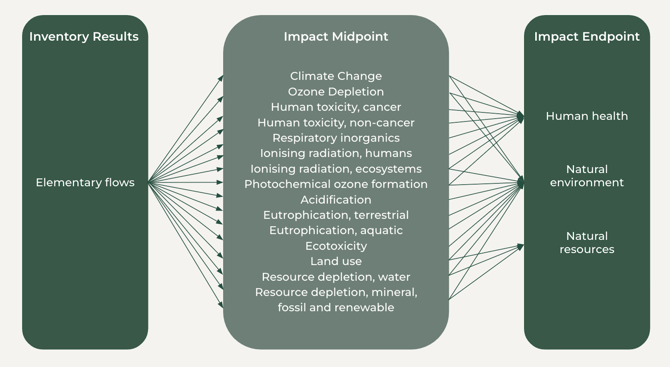
The 16 impact criteria are midpoint impact criteria, which are easier to calculate and understand than the final indicators, because they are closer to the source of the impact and less affected by uncertainties and assumptions.
Below are the impacts we can currently measure using the databases we use :
| IMPACT FACTOR | UNIT | DEFINITION | CONSEQUENCES |
|---|---|---|---|
| Acidification | mol H+ eq | Indicator of soil and water acidification due to the release of acidifying substances such as sulphur or nitrogen oxides. | Forest dieback, reduced biodiversity in aquatic environments. |
| Climate change | kg CO2 eq | Indicator of the potential for climate change due to greenhouse gas emissions. | - Extreme weather events - Ocean disturbance - Disappearance of species |
| Climate change-Fossil | kg CO2 eq | Inputs specifically centered around the emissions of greenhouse gases associated from fossil fuels | |
| Climate change-Biogenic | kg CO2 eq | Inputs specifically centered around the emissions of greenhouses gases from a biogenic sources and part of a biogenic cycle. A main example would be biomass burning for energy. | |
| Eutrophication marine Eutrophication, freshwater Eutrophication, terrestrial |
kg N eq kg P eq mol N eq |
Indicator of the accumulation of nutrients in an environment/ecosystem. Most nutrients come from agricultural fertiliser and accelerate the growth of algae. | The proliferation of algae has an impact on the availability of oxygen and natural light in the environment. The consequences include coral bleaching, damage to ecosystems and a decline in biodiversity. |
| Ionising radiation, human health | kBq U-235 eq. | Indicator that takes into account the harmful effects of radioactive discharges on human health. | Long-term effects: cancer and leukaemia. |
| Ozone depletion | kg CFC-11 eq | Indicator of the depletion of the ozone layer due to the emission of chemical products, Chlorofluorocarbons (CFCs), mainly from aerosols and refrigerants. | Impact on health and the environment: - Skin cancer - DNA mutation - Photosynthesis difficulties - Eye problems |
| Particulate matter | disease incidences | An indicator that takes into account the harmful effects of fine particles on human health. | Development of chronic diseases such as cardiovascular, respiratory and neurological diseases, and cancers. |
| Photochemical ozone formation - human health | kg NMVOC eq. | Photochemical ozone, also known as ‘smog’, is the formation of ozone at low altitudes caused by emissions of volatile substances. | A high concentration of ozone in the troposphere can cause damage to vegetation and to human respiratory health. |
| Resource use, fossils | MJ | Indicator of the use of non-renewable fossil resources such as natural gas, coal or oil. | Reduced accessibility, quality or purity of resources. |
| Resource use, minerals and metals | kg Sb eq | Indicator of the use of non-renewable abiotic resources such as minerals and metals. | Reduced accessibility, quality or purity of resources. |
| Land use | Pt | This indicator is related to the use (occupation) and conversion (transformation) of land area by activities such as agriculture, forestry, roads, housing, mining, etc. | Poor soil quality, erosion, disappearance of species. |
The other impact categories in the PEF methodology are not currently assessed in the databases we use.
| IMPACT FACTOR | UNIT | DEFINITION |
|---|---|---|
| Climate change-Land use and land use change | kg CO2 eq | Represents the complex inter-relation between land use and land use change with climate change |
| Human toxicity, cancer Inorganic Human toxicity, cancer organic |
CTUh | Indicator that reflects the adverse effects on human health caused by the absorption of toxic substances insofar as they are linked to cancer. |
| Human toxicity, non-cancer Inorganic Human toxicity, non-cancer organic |
CTUh | Indicator that reflects the adverse effects on human health caused by the absorption of toxic substances, insofar as they are not linked to cancer. |
| Ecotoxicity, freshwater * inorganics Ecotoxicity, freshwater organics |
CTU eq | An indicator that quantifies the toxic impact on aquatic ecosystems. There are many causes of ecotoxicity. |
| Water use * | m3 | This indicator assesses the potential for water deprivation, for humans or ecosystems. |
*Ecotoxicity, freshwater and water use indicators will soon be included.