Context, Objectives and Deployment Schedule
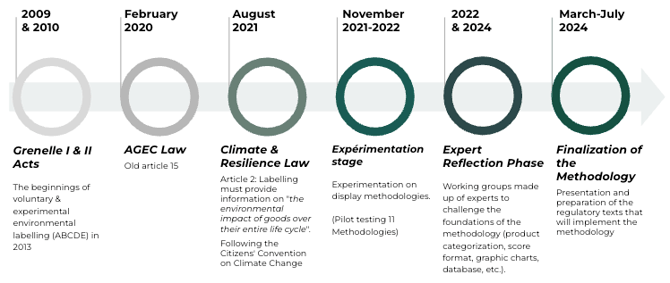
Environmental labelling is an initiative launched in 2009 as part of the Grenelle de l'environnement to raise consumer awareness of the environmental impact of products and services. Considered a major issue at the Citizens' Climate Convention, it was incorporated into the French Climate and Resilience Act of 2021 (article 2).
Since then, experimental phases have been launched, leading to the formalisation of a technical framework presented in March 2024.
The objectives of environmental labelling are to
- to inform consumers when making purchases by offering them a simple benchmark to help them choose products with a lower environmental impact,
- to encourage manufacturers and distributors to adopt eco-design approaches to help them switch to more sustainable production methods.
Since the presentation of the methodology in early spring 2024, a gradual phase of consultation on the methodology and legal texts has been underway. The finalisation of the work and the validation of the texts will lead, at the end of 2024, to the implementation of a voluntary system.
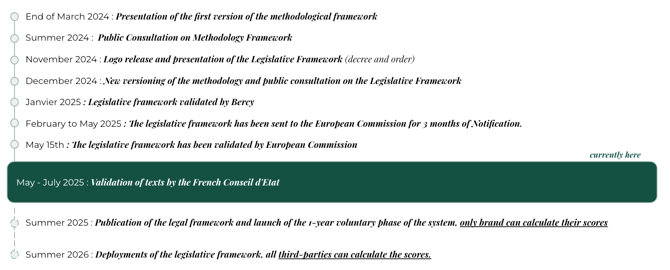
The legislative framework was validated by the French Ministry of Economy (Bercy) in January 2025, and subsequently notified to the European Commission, which gave its approval on May 15, 2025.
The final validation by the French Conseil d'État is expected in summer 2025, paving the way for the official launch of the system.
A one-year voluntary phase will then begin, during which only brands will be allowed to calculate their scores. At the end of this period, in summer 2026, the system will be fully deployed and accessible to all stakeholders, including third-party evaluators.
Legal framework
LOI n° 2021-1104 of 22 August 2021 states :
"A display intended to provide consumers with information relating to the environmental impacts [...] of a category of goods or services placed on the national market is made compulsory, under the conditions and subject to the reservations set out in Article L. 541-9-12."
"This display [...] shall be visible or accessible to the consumer, in particular at the time of purchase.
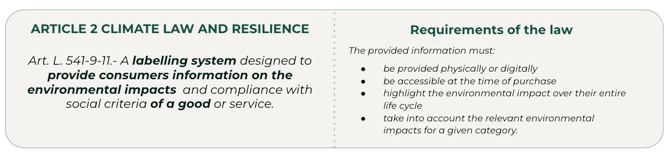
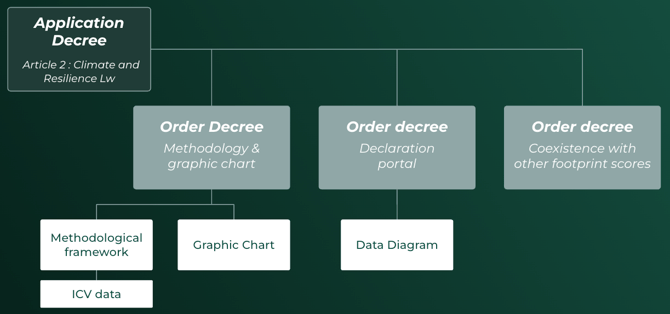
Application decrees and orders will subsequently specify the categories of products concerned, the methodology to be followed, the display modalities to be adhered to, as well as the declaration process to be completed through a government portal that will be established soon.
Product concerned
For textiles, the legislator has decided to initially focus on ready-to-wear clothing items. Footwear and leather accessories will be addressed at a later stage.
Key Information
- Applicable Products: All textile garments (new or upcycled) placed on the French market that fall within the defined category rules.
- Obligation Scope: The environmental score must be available at the SKU-color level for each product.
- Lot Products: For multi-item packs (e.g., socks, underwear), the environmental score must be calculated for the entire lot.
- Multi-Component Products: Each component (e.g., coat and removable lining) must be modeled separately, and the total score is obtained by summing the individual scores.
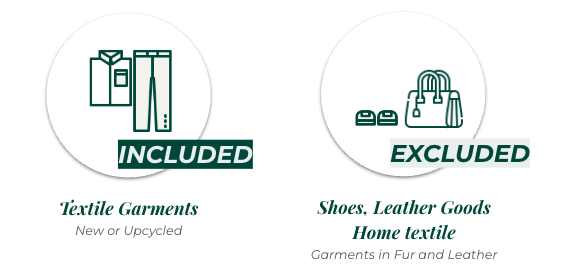
✅ Included
- Textile garments, whether new or upcycled
❌ Excluded
- Shoes, textile accessories, leather goods, and home textiles
- Garments made of fur or leather
- Single-use clothing
- Clothes with electronic components
- Textile products containing more than 20% of materials for which no data set is available in the Base EmpreinteⓇ
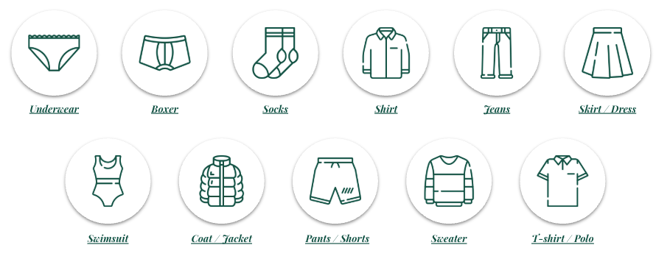
The following categories of products are concerned in particular:
Underwear, Boxer, Socks, Shirt, Jeans, Skirt / Dress, Swimsuit, Coat / Jacket, Pants / Shorts, Sweater, T-shirt / Polo.
Last Updates – CGDD Webinar (22 May 2025)
During the latest webinar organized by the CGDD on May 22, 2025, several updates were shared regarding the potential extension of the methodology to new product categories.
Some categories are currently under consideration for inclusion through infra-regulatory adjustments, meaning they could be added via a methodological update without requiring a new decree, as they fall within the scope of the current ministerial order. These could be added at minimum:
- Bras
- Multi-component products (e.g., coats with removable linings)
- Costumes
- New materials, such as silk
Other categories will require a new ministerial order to be added to the scope:
- Household linens (e.g., towels)
- Single-use textile clothing
- Textile products with electronic components
- Products with over 20% of their mass made from non-modelable materials
In summary, some categories can be added infra-regulatorily, while others will require a regulatory update through a new decree.
Technical and methodological framework
The display system is made up of several tools:
- the general principles and the methodological framework, which is based on the same frame of reference as the European Product Environmental Footprint (https://pefapparelandfootwear.eu/).
- Sectoral standards: these explain how the calculations should be made for each product category. For textiles, we have a sector standard that also adds additional indicators to the LCA, such as plastic microfibres and the impact of exports outside Europe.
- A database: [La Base Empreinte ®] (https://base-empreinte.ademe.fr/)
- Graphic charters:
-
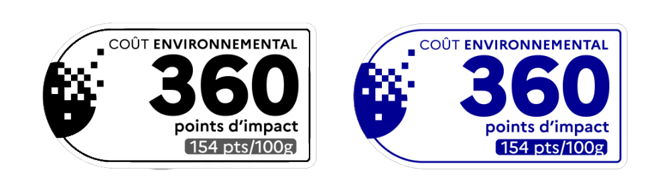
The official logo was released in November 2024
-
and we are currently awaiting the final graphic charter specifications from the legal framework, which will be provided upon validation by the French Conseil d’État.
-
What is "environmental cost"?
The environmental cost is the result of an impact calculation carried out in accordance with the sector benchmark proposed by the French government. This method is based on the European PEF base (Product Environmental Footprint) for carrying out the Life Cycle Assessment, with the addition of supplements relating to dimensions currently poorly covered by the PEF base

The environmental cost is expressed in terms of impact points.
This impact point comes from the "PEF micro-point". The PEF point corresponds to the annual environmental impact of one European inhabitant.
How to read it ? The lowest is the score the lowest impact have the product under the environment.
This "open" unit facilitates alignment with the PEF method, enabling its deployment across all goods and services and allowing comparisons between product categories. It also avoids the "good grade" effect that encourages consumption, thereby promoting material sobriety.
Methodology
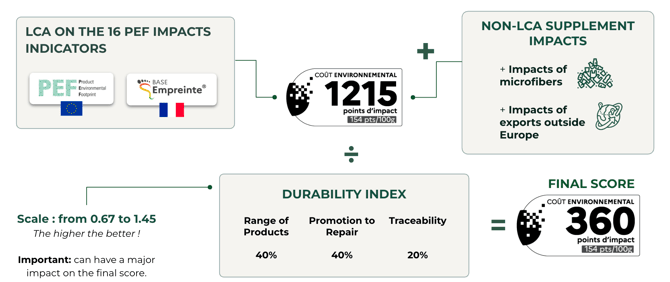
The main framework of this methodology is based on a Life Cycle Assessment (LCA) using the European PEF method.
This methodology employs a multi-step and multi-criteria approach to conduct an environmental accounting of a product throughout its entire life cycle.
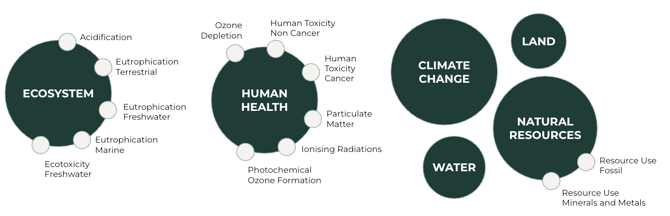
The results of this LCA are provided according to 16 standardized international criteria (ILCD).
How do we calculate a score in micro-points?
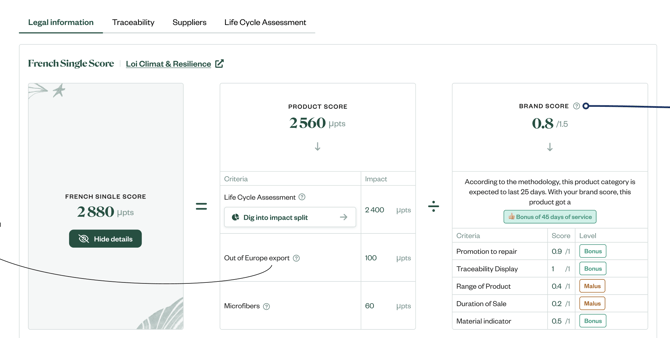
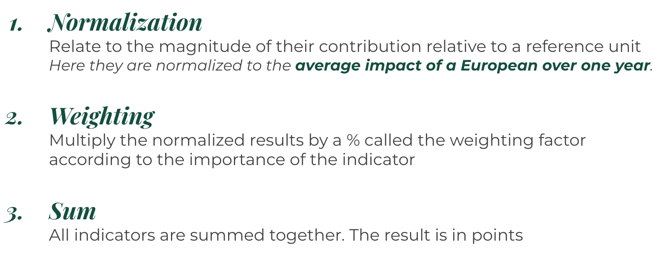
To convert the 16 impact criteria into a single score, the LCA results undergo three operations. Each criterion is normalized based on an average European citizen, which brings all indicators to the same unit, the "point". Then, each criterion is weighted according to its importance and scientific robustness as defined by the method, and finally, they are all summed to obtain a single score.
Supplementary Adjustments Outside of LCA and PEF Corrections
To address certain delays or limitations in the LCA methodology, the French government has opted to introduce corrections either directly within the LCA and database or outside the LCA when that was not possible.
The main adjustments are as follows:
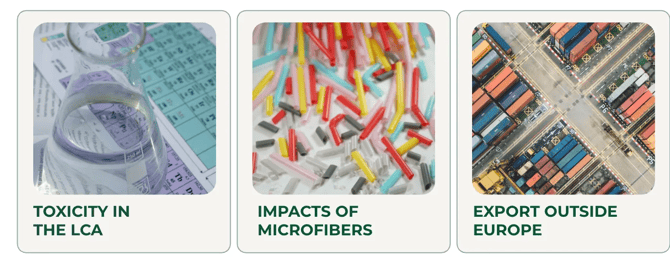
- Correction of toxicity in the LCA, allowing for better evaluation and valuation of organic cotton, for example.
- Integration of impacts associated with textile microfibers out the LCA.
- This additional indicator is calculated on the basis of a textile's capacity to release microfibres and their biodegradability in the environment. It is determined on the basis of the nature of the fibres present in the composition of the product.
- Addition of impact factors out the LCA to model the effects of exporting textiles at the end of their life outside of Europe.
- This addition is based on the end-of-life scenarios of a product and the likelihood of it becoming waste in a non-European country due to its composition. According to a study, a synthetic product is more likely to end up in an open landfill at the other end of the world.
Functional unit of the LCA and Durability
The PEF method introduces the concept of the number of wears in its methodology to account for the impact of a garment over a theoretical service life.
Two concepts are introduced to adjust this service life: physical durability and non-physical durability.
These two aspects have been added to model the physical or behavioral factors that could shorten or extend this theoretical service life.
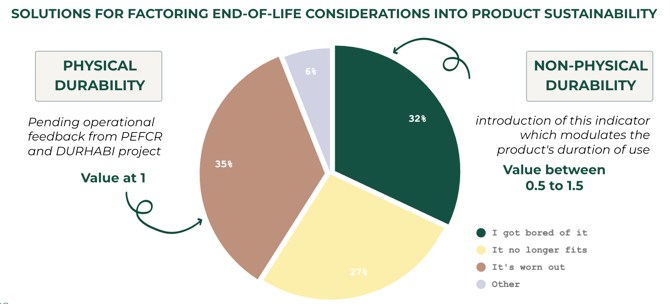
- Physical durability addresses the issue: "My garment has worn out."
- Work is in progress to take into account this sustainability, derived from the PEF methodology, and how the two durabilities co-exist. The methodology will be updated as soon as this work is completed.
- Non-physical durability addresses the issue: "I no longer like my garment; I have grown tired of it."
- This indicator will vary between 0.67 and 1.45 in order to extend or reduce this theoretical life.
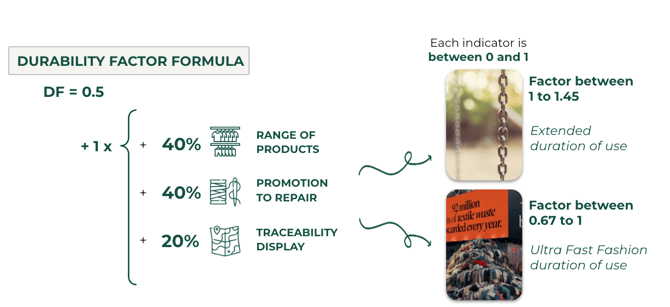
These durability factors therefore modulate the theoretical life of the garment:
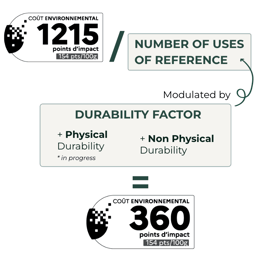
The lower the emotional durability, the more it will reduce the number of uses, so it will take more products than expected to fill the theoretical service life it was supposed to have, which will increase its impact. On the other hand, the greater the durability, the longer the product will last and the lower the impact on the theoretical service life.
This non-physical durability index is made up of 3 criteria
- The range of product
- The promotion to repair
- The traceability display
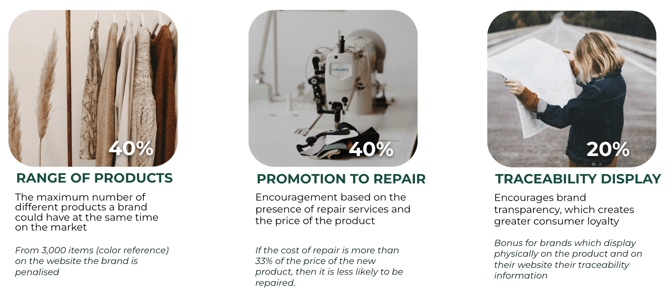
To summarize
The environmental display method is first and foremost an LCA based on the 16 ILCD criteria, which follows the PEF framework using the corrected footprint base. The LCA is then transformed into a single score.
Non-LCA impacts are then added to the score and the results are modulated by the sustainability index to obtain the final score.
Find out more about the French Environmental Labelling in the Fairly Made Platform's
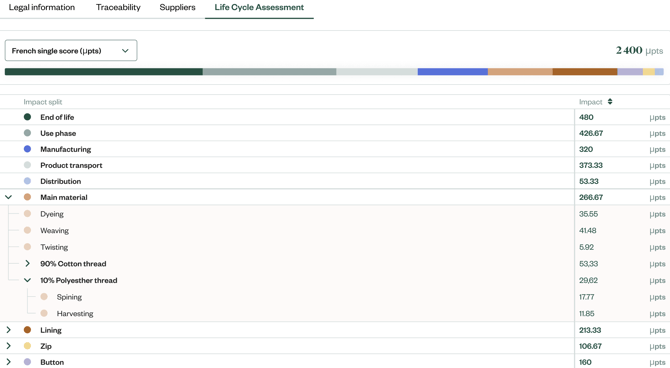
- A CLEAR IMPACT DISTRIBUTION BY STEPS
In the LCA tab, you will find for each product the distribution of its impacts throughout its life cycle. This will enable you to easily identify the areas with the highest impact.
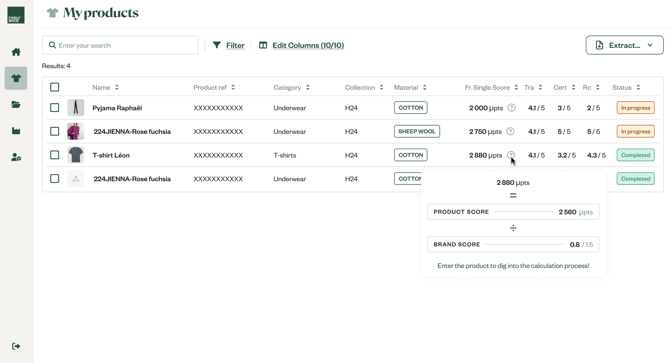
- A SCORE OVERVIEW ON ALL MY PRODUCTS
The single score will be available for all your products in the tab My product. Mouse over the "i" for more details of the calculation.
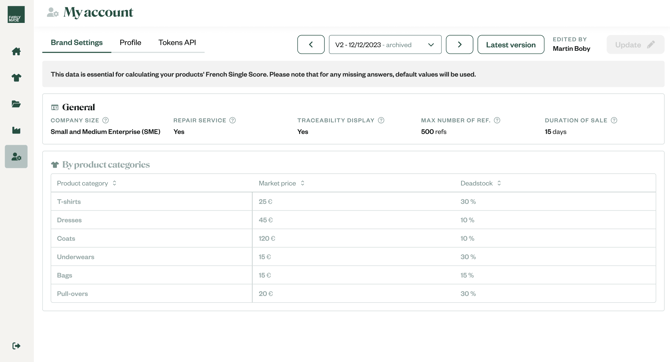
- SET YOUR COMPANY DATA TO CALCULATE MORE PRECISELY YOUR BRAND INDEX
Your brand data for calculating the non-physical durability index will be entered in a dedicated tab, saving you time in the calculations.
- UNDERSTAND THE DETAILS OF CALCULATION
All the details of the calculation directly available under “legal information” tab