
Labels, Audits, and Certifications: What’s the Difference?
In the textile industry, labels, certifications, and audits have become essential tools in response to the growing demand for transparency, sustainability, and social responsibility. As consumers become increasingly mindful of the environmental and ethical impact of their purchases, these tools help ensure more responsible production practices.
💡 Understanding the differences:
- Audits are external assessments conducted by specialized organizations to analyze a company’s practices.
- Certifications are obtained after a successful audit and confirm compliance with specific requirements. They may cover areas such as working conditions, traceability, or environmental impact.
- Labels (like GOTS, Oeko-Tex, Fairtrade, Bluesign, etc.) act as consumer guides. They guarantee that a company or product meets certain criteria and are usually represented by a recognizable logo.
How Does the Certification Process Work?
In France, the COFRAC (French Accreditation Committee) plays a key role by authorizing certification bodies that award certifications to eligible companies. These certifications confirm compliance with specific standards related to quality, safety, and sustainability.
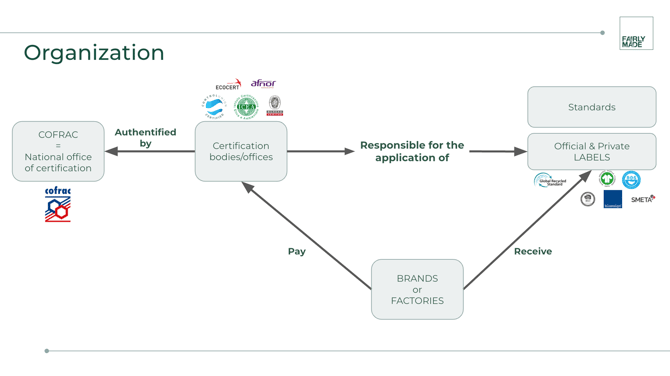
Labels are markers of recognition that assure consumers the certified products or services meet defined requirements. They are usually associated with specific sectors and help differentiate companies committed to ethical and sustainable practices.
💡 Why are labels so important?
Their distinctive logos offer a real guarantee of trust for consumers and act as a powerful marketing tool for businesses. Displaying a recognized certification allows a brand to demonstrate its commitment and build customer loyalty.
How Does a Factory Obtain a Certification?
Getting a label or certification involves a structured process:
1️⃣ Audit and evaluation: A certification body analyzes whether a company meets the criteria of the desired label.
2️⃣ Certificate issuance: If successful, the company receives an official certificate.
3️⃣ Regular inspections: Follow-up audits are conducted to ensure ongoing compliance with the standards.
💰 Note: Companies finance these certifications themselves, including the regular audits required for renewal.
Different Types of Textile Certifications
Textile certifications fall into three main categories:
1️⃣ PRODUCT Certifications
These certifications guarantee that the final product complies with specific standards of quality, safety, and performance. They focus on:
✔️ Composition (e.g. GOTS for organic textiles)
✔️ Absence of harmful substances (e.g. Oeko-Tex Standard 100)
✔️ Environmental impact (e.g. Global Recycled Standard)

2️⃣ SOCIAL Audits
These assess whether working conditions and employee rights are respected in textile factories. Examples include:
✔️ BSCI (Business Social Compliance Initiative)
✔️ SA8000 (Social accountability standard)
✔️ ICS (Initiative for Compliance and Sustainability)

3️⃣ PROCESS Certifications
These ensure that production methods meet strict environmental and social standards. Examples:
✔️ SAI (Social Accountability International)
✔️ LWG (Leather Working Group)
Why is Certification Essential?
In summary, a certification is an official validation issued by an independent body confirming that a company or product complies with specific standards in quality, sustainability, and social responsibility. It serves as a mark of credibility for companies and a guarantee of trust for consumers.