I. Why the environmental cost matters for apparel brands
Context
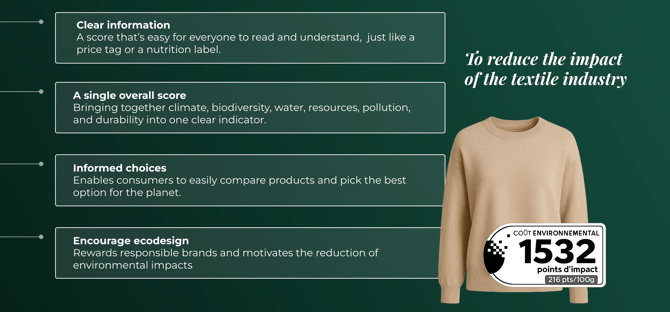
The idea of environmental labeling was first introduced in 2009 during the Grenelle de l’Environnement, aiming to make consumers aware of the ecological impact of their purchases. It later became a key measure of the Citizens’ Climate Convention and was formally enshrined in the Climate and Resilience Act of 2021.
Following several pilot projects, a technical framework for the label was unveiled in March 2024, defining how environmental impacts would be assessed and displayed. The initiative has two main goals:
- Inform consumers with simple, comparable data on product impacts;
- Encourage companies to adopt eco-design practices and reduce their footprint.
Starting October 1, 2025, the environmental cost of textile products becomes a regulatory reality for all brands selling in France. The French Council of State has validated the texts governing environmental cost, confirming both the timeline and the methodology to be applied. For fashion and textile players, this deadline represents a major turning point in how they communicate their ecological impact and build trust with consumers.
Why brands should adopt early: strategic & competitive arguments
Managing reputation & controlling the narrative
If brands delay, they risk others computing a French environmental cost based on default parameters (from October 2026). By computing and publishing your own scores, you maintain narrative control and avoid being misrepresented.
Anticipating regulation & avoiding last-minute rush
Because the French framework is likely a bellwether for broader European labeling (e.g. via the Digital Product Passport, and sustainability claims), early adoption helps brands structure processes, collect data, and avoid scrambling when obligations become mandatory.
Encouraging internal improvement & eco-design
The calculation of environmental cost, formerly known as Ecoscore forces brands to examine their supply chains, material choices, transport modes, and product life cycle, highlighting hotspots and opportunities for improvement. Over time, scores can drive design optimization, material substitution, and process innovation.
Marketing & differentiation
Displaying a lower French environmental cost (i.e. lower impact) can appeal to conscious consumers, especially as awareness grows. It becomes a differentiator in a crowded marketplace.
In sum: adopting it now is not just compliance: it’s a strategic investment.
II. What are the deployment schedule and the scope
Key dates for environmental cost regulations
The new environmental labeling system is being rolled out according to a precise timeline:
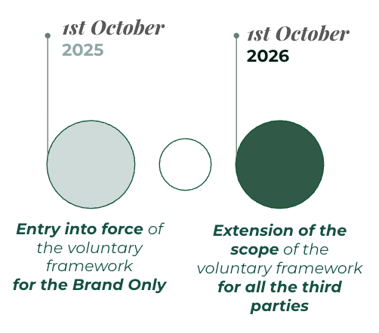
- October 1, 2025: official entry into force of the scheme on a voluntary basis. From this date, products will have to display their environmental cost using the approved visual format.
- October 1, 2026: from this date, any stakeholder can calculate brands' scores (external solutions, other brands, etc.). For this reason, controlling the environmental score before 2025 reduces reputational risks and avoids external calculations based on potentially inflated data.
The official graphic charter for the score has already been published, ensuring consistent and consumer-friendly presentation.
Initial scope: textile garments
The current regulatory scope is narrowly focused on textile garments, i.e. clothing items primarily made of textile fibers, whether natural or synthetic.

Examples of covered categories include:
- Socks
- Underwear
- T-shirts, polos
- Sweaters, pullovers
- Pants, shorts
- Coats and jackets (with removable components modeled separately)
- Lot Products: For multi-item packs (e.g., socks, underwear), the environmental score must be calculated for the entire lot.
- Multi-Component Products: Each component (e.g., coat and removable lining) must be modeled separately, and the total score is obtained by summing the individual scores.
However, certain products are explicitly excluded:
- Shoes, textile accessories, leather goods, and home textiles
- Garments made of fur or leather
- Single-use clothing
- Clothes with electronic components
- Textile products containing more than 20% of materials for which no data set is available in the Base EmpreinteⓇ
Obligations & penalties
Although the first phase is voluntary, certain obligations already exist:
- All required data and calculation outputs must be declared via the government portal.
- If a brand uses another environmental claim or label, it must also display the official French environmental cost.
- Display rules (logo, format, per-100 g information) must follow the graphic charter.
As for sanctions, under the French consumer code, failure to comply (e.g. making environmental claims without displaying the official cost) may expose:
- Up to €3,000 for natural persons
- Up to €15,000 for legal persons
III. How the environmental cost calculation works
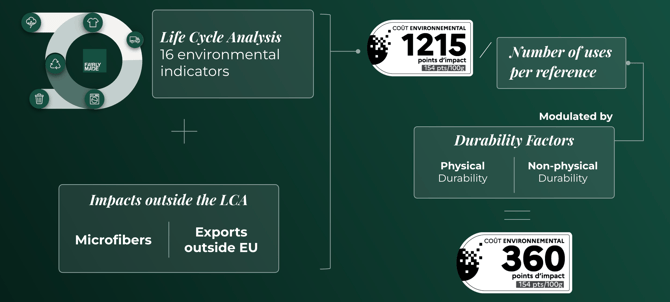
The French environmental cost is a numerical score expressed in “impact points”, designed to represent the aggregated environmental impacts of a product over its full life cycle. The lower the score, the lower the environmental cost.
Core concept: Life Cycle Assessment (LCA) + supplements
To address environmental impacts that are underrepresented or not fully captured by classical LCA, the French method introduces additional adjustments, including:
- Toxicity corrections
Adjustments to toxicity and ecotoxicity indicators improve the assessment of impacts not fully reflected in standard LCA, enabling a more accurate evaluation of certain materials. - Textile microfiber release (outside LCA)An additional indicator accounts for microfibre release during washing, based on fibre composition and the biodegradability of released microfibers.
- Exports of used garments outside Europe (end-of-life leakage)Additional impact factors reflect the risk that exported textiles become waste in non-European countries, depending on product composition and end-of-life scenarios.
- Physical and non-physical durabilityPhysical durability addresses product wear, while non-physical durability captures loss of consumer interest through lifespan adjustment coefficients.
Physical and non-physical durability
Two complementary notions refine the product’s service life: physical durability and non-physical durability.
These elements model both material performance and consumer behavior, factors that can either extend or reduce a garment’s lifespan.
You can find below the formula of the durability coefficient:

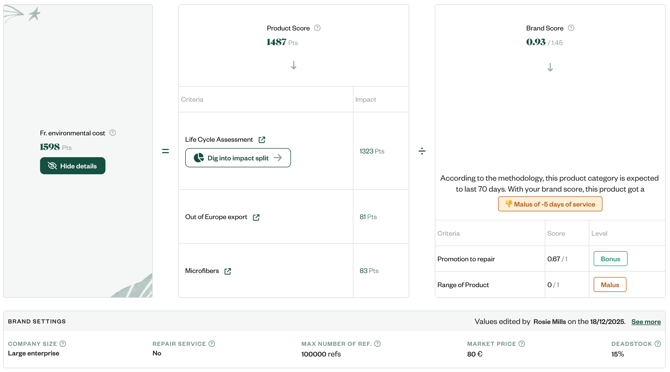
💡 At Fairly Made, we call the durability coefficient, the "brand score". This score is partly calculated thanks to the brand settings available in My account. Take the time to enter your information as this allows you to reflect your brand as closely as possible.
Physical durability
The physical durability component (assessing the actual lifespan of materials, resistance to wear, and product robustness) is not yet included in the current version of the methodology.
It is under development and will be introduced in a future update of the official framework once standardized modeling criteria are finalized.
Non-physical durability: impact outside LCA
This concept evaluates a product’s potential longevity beyond its material quality. It is based on two weighted criteria:
1. Range of products (50%)Reflects the maximum number of different products a brand offers on the market at the same time. A wide product assortment can reduce product longevity by encouraging faster renewal cycles.
The “product range breadth” index takes the following values:
-
100% where the number of SKUs per segment is less than 1,000
-
50% where the number of SKUs per segment is 7,000
-
0% where the number of SKUs per segment exceeds 16,000
-
Between these points, the index changes linearly
2. Incentive to repair (50%)
Measures how effectively a brand encourages product repair by combining repair pricing and the availability of repair services. When repairs are accessible and affordable compared to the purchase of a new product, items are more likely to be repaired and kept in use for longer.
For large enterprise (more than 250 employees): Incentive to repair = 66% x I1 + 33% x I2
For small and medium enterprise (SME): Incentive to repair = 100% x I1
With I1 :
-
100% if the repair cost is less than 33% of the reference new price
-
0% if the repair cost exceeds 100% of the reference new price
-
Between these points, the index varies on a linear basis.
| Product category |
Average repair cost |
|
Shirts |
€10 |
|
T-shirts |
€10 |
|
Sweaters |
€15 |
|
Jackets |
€31 |
| Trousers |
€14 |
|
Skirts |
€19 |
|
Socks |
€9 |
|
Underwear |
€9 |
|
Accessories |
€9 |
Average repair cost for each product category
With I2 :
-
0% if the brand does not offer a repair or warranty service that meets the minimum requirements
-
100% if the brand provides at least one in-house repair service certified by the producer responsibility organisation overseeing the EPR scheme for apparel, household linen and footwear.
Thus, even with two identical garments (in terms of materials and manufacturing), additional criteria related to brand policies and market approaches may lead to different French environmental cost scores.
How is the environmental cost score calculated?
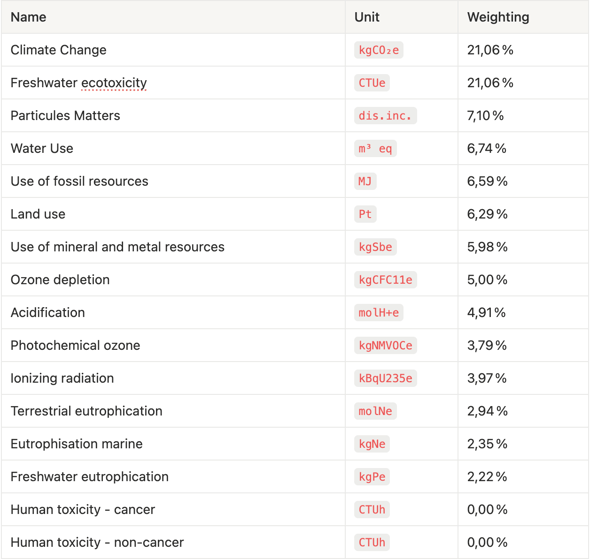
To transform the 16 environmental impact categories into one overall indicator, the LCA results go through three key steps. First, each impact is normalized against the footprint of an average European citizen, converting all indicators into a common unit, the “point.” Next, every category is weighted according to its relative significance and the scientific reliability of available data. Finally, the weighted results are aggregated to produce a single, comprehensive score.
In formula form:
Final score = (normalized and weighted sum of LCA impacts) + non-LCA adjustments, adjusted by durability coefficients.
Interpretation & display
-
This is a voluntary framework; the brand may decide to submit scores without necessarily displaying them.
- The global score is expressed as points of impacts.
- A normalized per-100 g value is also displayed to allow size-mass comparisons.
- In practice, the label must be displayed at the SKU-color level (each product variant).
- Environmental cost must be declared on the Government Platform before being displayed.
- Label must follow the official graphic charter (colors, font, format).
- Physical display:
- Placed near product price.
- At least the same size as the price.
- Legible from 50 cm.
- No misleading visuals.
- From Oct. 2025 to Oct. 2026: only manufacturers/importers/retailers can calculate and declare the environmental cost.
- From Oct. 2026: any third party can calculate and declare the environmental cost.
In short: French environmental cost is a multi-dimensional score, combining LCA, extra corrective factors, and brand-influenced durability modifiers, to yield a single, comparable indicator of environmental footprint.
> For more information on the methodology, please go the official documentation from the French government: Guidance Note For Calculating The Product Environmental Footprint ǀ 01/10/2025 - Environmental Footprint Labelling For Items Of Apparel
IV. How Fairly Made can support you
Fairly Made, leader in French environmental cost measurement for fashion:
With over 60% of products officially declared through our platform, Fairly Made is the leading solution for measuring the environmental cost of fashion products. This milestone demonstrates our ability to help brands understand, reduce, and manage their environmental cost, turning sustainability into actionable insights.
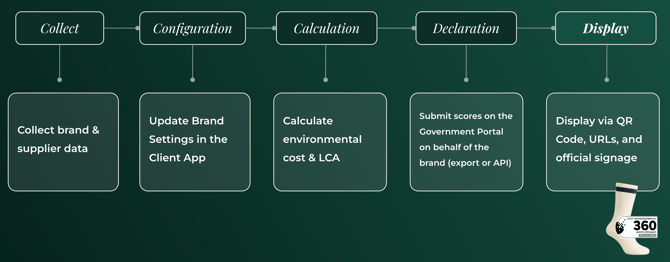
Step-by-step process with Fairly Made
Here is how we work together to ensure compliance:
On your side:
Delegate Fairly Made:
-
Create an account on the Government Portal via ProConnect:
-
Confirm your email address using the validation code you received.
-
Choose a password.
-
Enter your organization's SIRET number (available in the Business Directory—new window).
-
Fill in your personal information.
-
Your account has been created!
-
- In the “My Company” section, delegate to Fairly Made using SIRET 83994219000019
-
-
Verify that delegation is active
-
Communicate to Fairly Made your company legal name
-
-
In Fairly Made platform, go on My Account and update your settings:
-
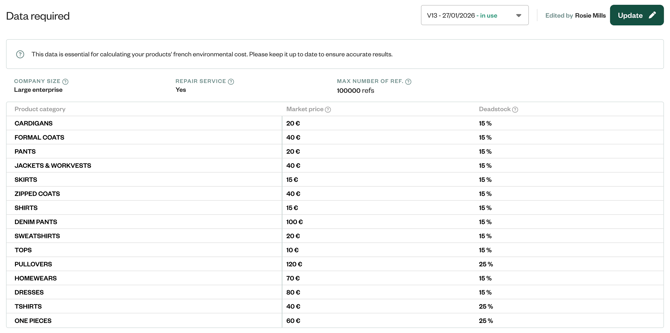
Product range (maximum number of references)
-
Repair policy (repair service and market price)
-
-
Share with your analyst the GTIN/EAN codes of the concerned products.
On Fairly Made’s side:
- Calculation of the environmental cost:
- Environmental cost and LCA calculated using the official methodology
- Automated declaration on the Government Portal:
- Submit scores automatically to the Government Portal on behalf of the brand
- Display of the environmental cost on the showcases:
- Official environmental cost integrated into product's showcase with approved label design
V. Bring the environmental cost into your daily workflow
1. Enter your brand settings
- To custom your brand score (durability coefficient), update your settings in My account.
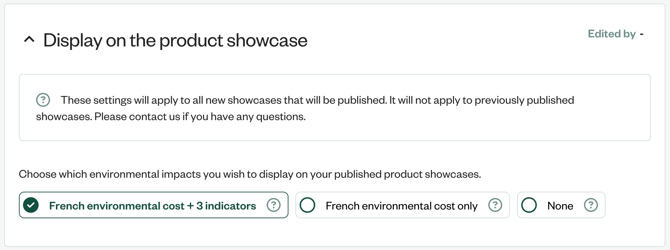
2. Choose what to display in your showcase autonomously
-
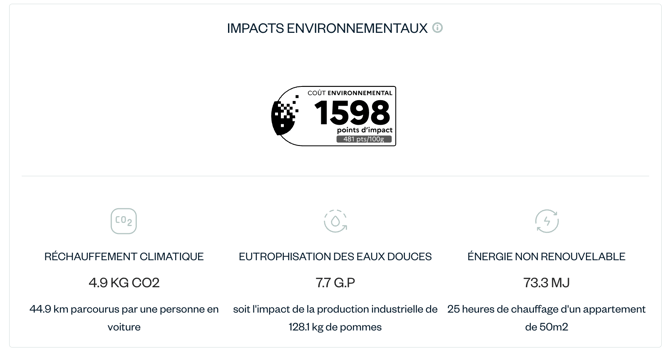
If you have delegated Fairly Made to publish scores on the government platform, you can now choose autonomously from My account, which environmental impacts are displayed on your product showcases.
-
You can decide to show :
-
The French environmental cost only
-
The French environmental cost along with the three usual PEF indicators
-
No environmental impacts at all
-
3. Customize the impact overview
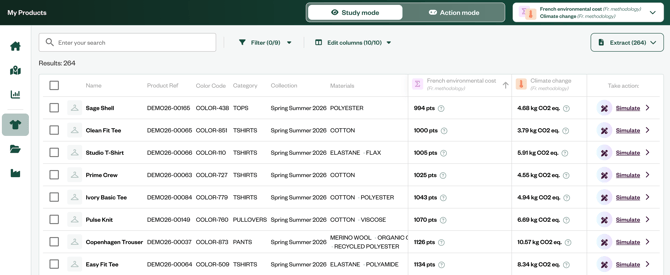
- View environmental impact for each product according to the indicator of your choice.
- Instantly evaluate environmental impacts on one page
for easy comparison.
4. Dig deeper into the score calculation
-
For each product, a dedicated section on the environmental cost is available in the Legal insights tab. You can better understand all the parameters taken into account to calculate the final score.
5. Get access to your product impact breakdown
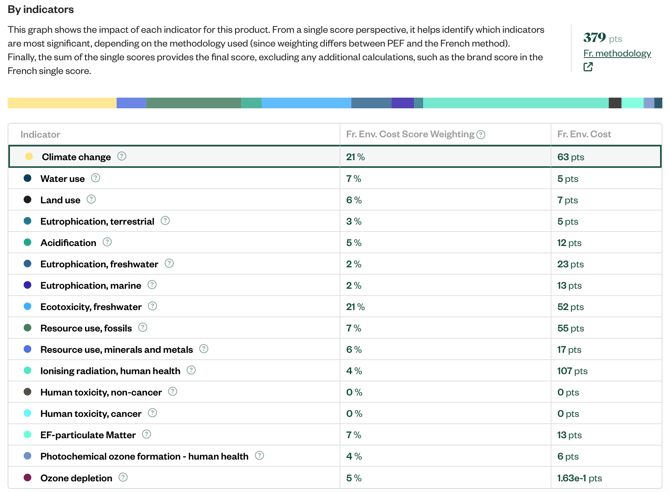
- Access the impact breakdown tab for each product to explore lifecycle stages.
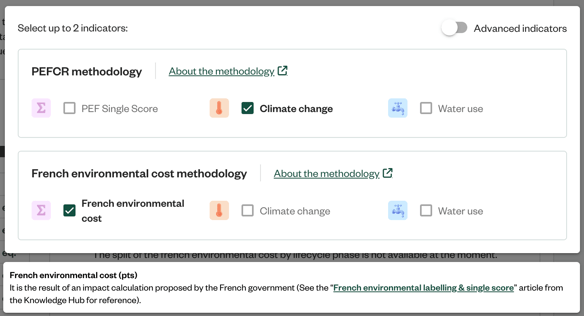
- Display up to 2 indicators simultaneously to analyze side-effects and trade-offs.
- Dive into detailed impact information, including the weighting of each impact indicator.
6. Select the indicators that truly matter
- Select any of the 16 indicators from the French or European methodology.
- Compare the same indicator across both methodologies for a clear side-by-side view.
- Benefit from in-app tooltips and Knowledge Hub articles for expert guidance and context.
7. Extract the data you need
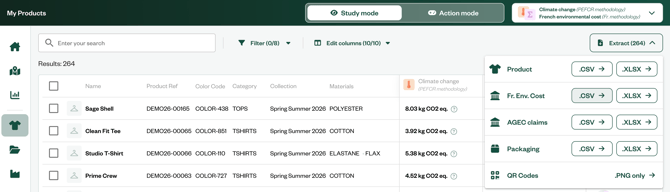
- Use the extract button to export all the data you need: from the French environmental cost information to the product showcases QR codes that display the score.