
The European Commission is developing an impact calculation method for consumer goods called the Product Environmental Footprint (PEF). Already established for other product categories, the PEF for textiles is set to be finalized in 2025/2026.
The PEF establishes a common framework for European states to conduct Life Cycle Assessment (LCA) of products. This ensures that environmental impact measurement adheres to precise and scientifically sound rules. To specify category-specific rules for environmental footprint measurement, the European Commission is developing Product Environmental Footprint Category Rules (PEFCR or PCR).
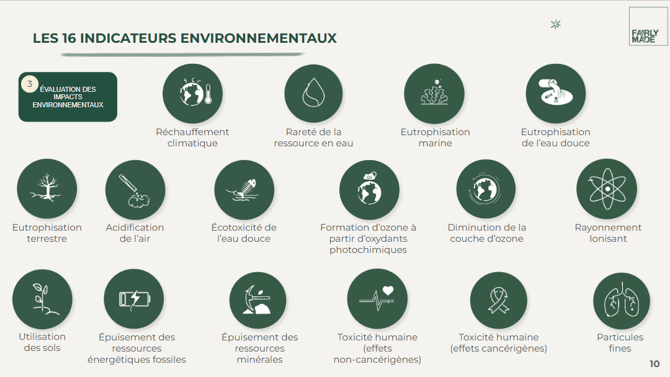
💡 To quantify the environmental impact of a product on the environment, the PEF introduces 16 impact indicators that encompass issues related to human health, impacts on natural resources, and ecosystem impacts.
To make these results easily comprehensible for consumers, the PEF has developed the PEF Score. This PEF Score is presented in Points (where one point corresponds to the average annual impact of a European) and provides an overview of a product's environmental footprint throughout its lifecycle.
PEFCR
An updated version of the rules of the PEF for the textile sector (Product Environmental Footprint Category Rules or PEFCR) was under consultation until the end of April 2024, proposing improvements like adjustments to LCA limitations.
The PEFCR initiative aims to standardize European regulations and methodologies for evaluating product environmental impacts, increasing result comparability and scalability in the apparel and footwear sector.
Backed by broad industry representation and oversight from the commission and NGOs, PEFCR offers a consistent methodology that reduces lifecycle assessment costs, enhancing accessibility to sustainable practices.
This initiative empowers consumers by countering greenwashing, enabling accurate communication of environmental impacts by governments and brands, and facilitating product comparisons.
💡 Regarding the project's governance, several organizations are involved in developing this methodology:
1. Technical Secretariat: It constitutes a consortium of industry-associated stakeholders, operating under the guidance of the European Commission. Its primary responsibility involves crafting sector-specific regulations that delineate the application of the PEF method. It includes:
- Voting members (financial contributors involved in practical cases)
- Non-voting members (provide advisory input without active participation)
- Observers
2. Quantis:
It serves as the technical expert within the Technical Secretariat. It is an environmental analysis consultancy specializing in sustainability assessments. Quantis is responsible for writing the methodology and conducting practical cases. It acts as a liaison between the Technical Secretariat and brands.3. ADEME: It is a voting member representing France's interests within the Technical Secretariat alongside Refashion. ADEME is the French government's agency for ecological transition, offering subsidies to ensure France's active leadership in environmental decisions.
The Role of Fairly Made®️
Fairly Made®️ is one of the accredited firms selected to assist brands in conducting additional supporting studies. Fairly Made®️ supports fashion brands by addressing their questions, concerns, challenges, and more. As a liaison between brands and the Technical Secretariat, Fairly Made®️ ensures a smoother process for brands participating in the PEF methodology.
When will it be finalized?
The finalized version of the PEF, specifically for the textile industry, is anticipated to be completed by 2025.
Fairly Made is working to integrate this score as precisely as possible in the coming months.