
Typical Fairly Made Roadmap
The typical API implementation process lasts about 4 months, split equally between Preparation and Testing. This duration may vary depending on the resources available within your company. Complete the Fairly Made data & IT diagnostic form here to help us understand your needs.

We usually plan for 2 months of Preparation, which consists of :
- Presentation of the process and review of the API documentation
- Data Mapping & Gap Analysis
- Transcodification
Then there are 1-2 months of Brand API connection development, and then at least a month of testing :
- Definition of the testing approach
- Preparation of the systems and applications
- Unit testing
- System testing
And finally we go live !
A RACI matrix, which clarifies roles and responsibilities, along with a more detailed roadmap, can be provided for further insights.
API Documentation Review
This step involves jointly examining the API documentation, allowing you to become acquainted with it and enabling you to conduct your testing and usage independently.
We have designed this documentation to ensure you don't need to depend on others for your data imports and retrieval.
Data Mapping & Transcodification
Transcodification is the process of converting or adapting a system (legal, linguistic, or technical) into another form while maintaining its meaning.
During the Data Mapping stage, we verify that you have all the information you need to conduct a Fairly Made study. This includes data on Suppliers, Components, Products and, if relevant, Packaging, which is generally stored in your PLM and/or ERP system.
Next, we determine if any information is lacking, where it can be sourced, and how to modify it to comply with our data model's standards.
The Transcodification stage then matches your taxonomies, nomenclatures with those expected by our Data Model.
If you have previously completed the Data Collection using the traditional method (through the spreadsheet Brand Data Collection, "BDC".csv file) with one of our Analysts, much of this work is already accomplished.
The data formatting rules are identical for both the spreadsheet and the API.
Test Environments & Request Types
We have two distinct environments for API usage, each accessible with its own Bearer Token:
- Sandbox environment is used for testing. It does not constitute a replicate of production and will only be filled with the tests we have agreed on.
- Production is where you will post and get your real data.
For each environment, you can access your data on app.sandbox and app.fairlymade.
We have two types of requests: POST and GET.
- The POST requests are used to put IN data, that can come from your ERP/PLM/Data Hub.
- The GET requests are used to get data OUT : the results of our studies to your ERP/PLM/PIM/Data Hub.
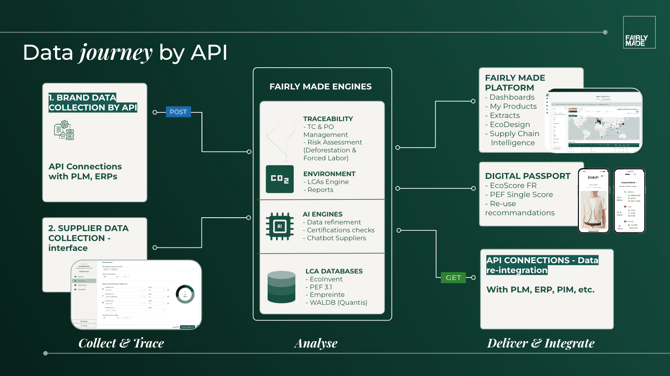
This means that any data submission is final, and updates are only possible in exceptional circumstances.
Any study modification requires new suppliers or supply chain adjustments, fundamentally altering the analysis. This would affect traceability, environmental assessments, and impact distribution, increasing analysts' workload and potentially delaying timelines.
From Tests to Go-Live
Typically, we choose a handful of test products to utilize in our sandbox environment, as we advocate for learning through practice; if needed, we can supply a comprehensive set of test products to spare you the trouble of predicting every possible scenario.
This is now the time for your (or your integrator’s) team to actually develop that connection, set up the routines, store the results, etc.
The specifics of the data to be submitted and the method for doing so can be found here and in the API documentation here.
After completing the unit tests and validation, we will be prepared for your initial collection import through the API!
Of course, we are available to support your developers during this time if needed.
If you have any other questions, suggestions or informations that you are seeking, please email us at guillaume.babule@fairlymade.com or clotilde.bazin@fairlymade.com, or directly book a meeting with us here.