
Compare your products' environmental impact against real market data from over 100,000 product references. Understand where you stand, identify improvement opportunities, and assess your readiness before making impacts public.
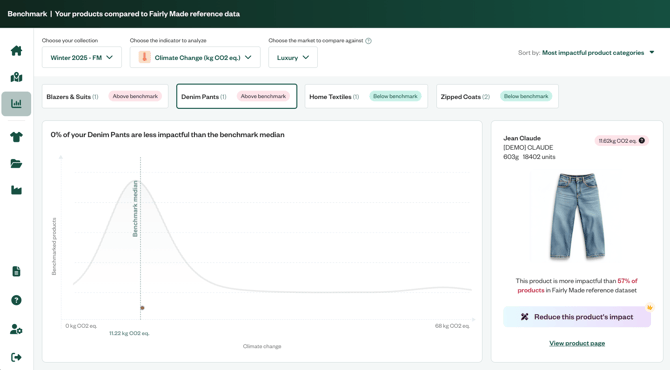
Key concepts
What you're being compared to
The benchmark draws on 100,000 product references across ~90 product categories from fashion brands using Fairly Made. This extensive dataset provides a reliable market baseline that reflects real-world production practices and environmental performance across the industry.
Your products are positioned within this distribution according to their category (e.g., Jackets & Workvests, Dresses, T-shirts) and you choose the market segment: your own (Luxury, Premium & Accessible Luxury, or Mass Market), a different one, or the entire market. This flexibility lets you compare like-for-like within your positioning, or see where you stand across all price points.
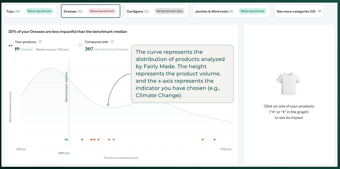
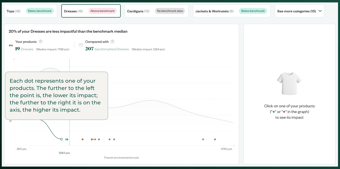
Why this matters: With such a large reference pool, the benchmark provides statistically robust comparisons. You can trust that your results reflect genuine market performance, not a handful of examples.
Market segments
Compare against different segments for the most relevant context:
- Luxury: Coats priced above €1,000, dresses above €600
- Premium & Accessible Luxury: Coats €200–1,000, dresses €250–600
- Mass Market: Products below these thresholds
Segment definitions ensure both statistical reliability and full anonymity: each comparison draws from enough products to be meaningful while keeping individual brand data confidential.
Environmental indicators
Three indicators are available:
- Climate Change (CO₂) Computed by Fairly Made using the French methodology
- French Environmental Cost Calculated using the official Ecobalyse methodology, reflecting environmental impact as defined by French regulation
- French Environmental Cost per 100g Normalized by weight to focus on material performance independently of total product weight
How to read the results
Here's how to navigate the benchmark, from a high-level overview down to individual products.
1. Choose your perimeter
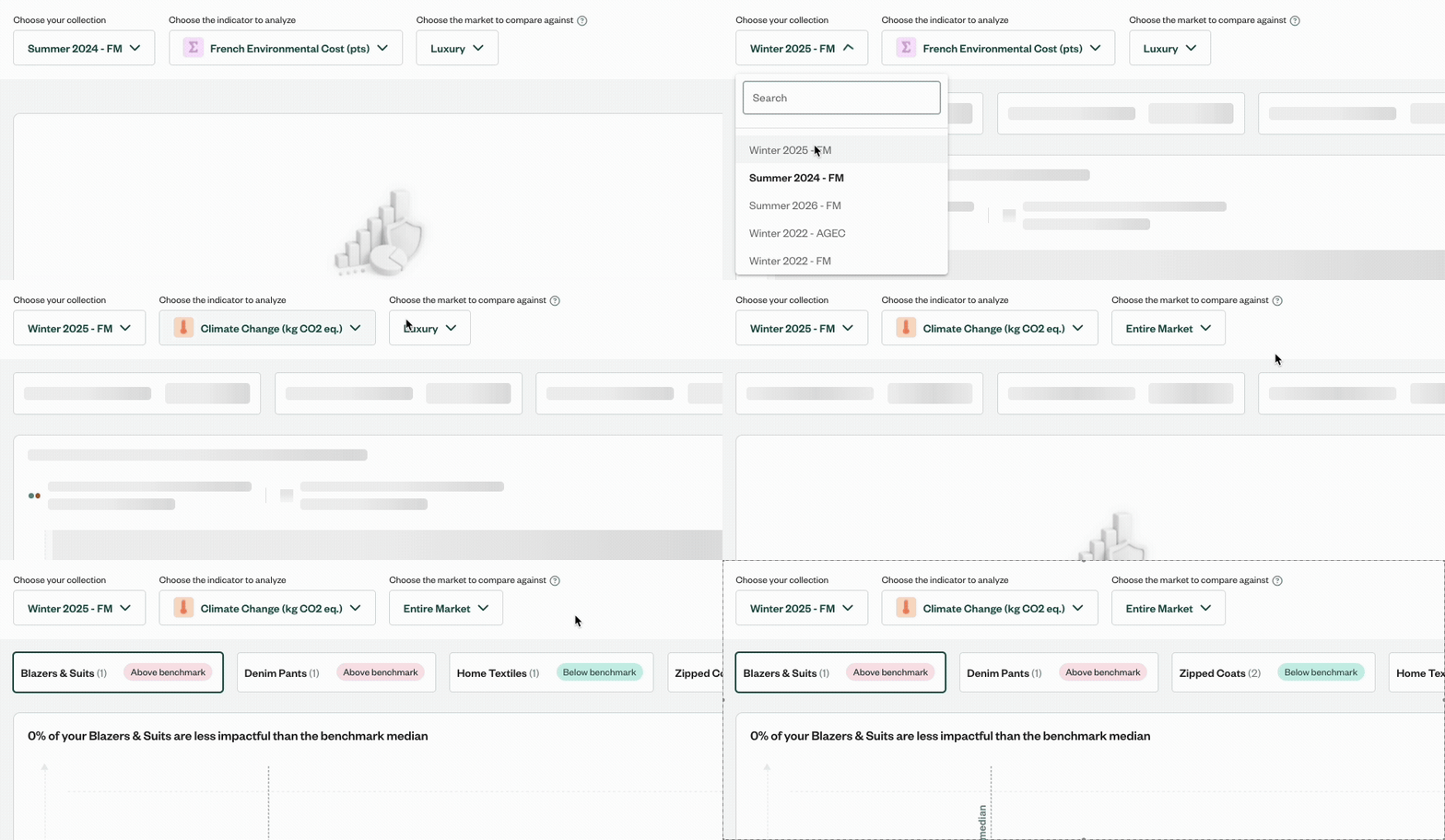
 Start by selecting the scope you want to analyze: a specific collection, a market segment, an environmental indicator, or all of them.
2. Get a performance overview by category
You can immediately see how your categories perform relative to the market. Sort them by most impactful, least impactful, or largest (most product references).

In this example, Pants are performing better than the market, while Dresses and T-shirts have higher impact.
3. Dive into a specific category
Select a category to see more detail. Here's what you'll find for Jackets & Workvests:
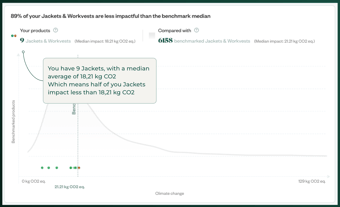
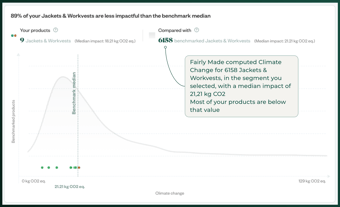
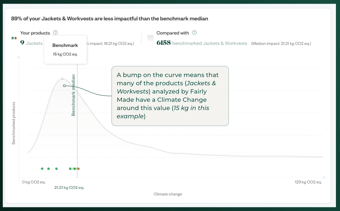
89% of your Jackets & Workvests are less impactful than the benchmark median
This means your products in this category are doing particularly well compared to the market. You're in the least impactful tier.
4. Focus on individual products
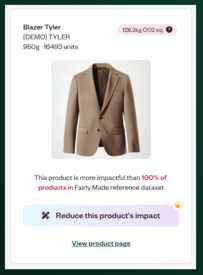
When a product significantly underperforms (has much higher impact than the market), you can drill down to understand why.
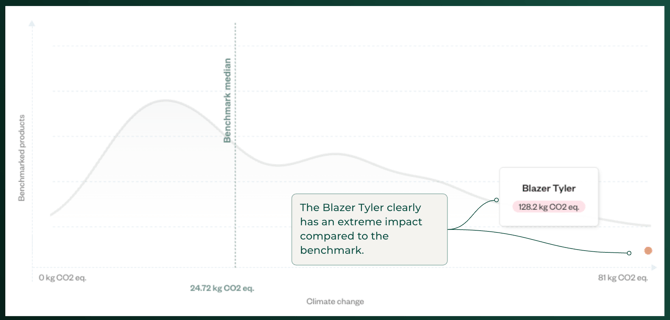
In this example, the Tyler blazer has a much higher impact than the market average. This is where you'd investigate further: What's driving the impact? What could be changed for future collections?

5. Why some categories show no data
You may encounter categories with no benchmark available. This happens in two cases:
- Not enough data yet. To ensure statistically meaningful comparisons, we only display benchmarks when at least 100 products exist in a given category and segment, including a minimum of 50 from other brands. As our dataset grows, more categories will become available.
- Category out of scope for this indicator. The French Environmental Cost methodology only covers specific product categories. We display all your categories so you have a complete view, but benchmarks are only available where the methodology applies.
What's next?
Once you've identified products with room for improvement, use Ecodesign to simulate alternatives: different materials, suppliers, or production methods. See how they would affect your environmental performance.
Good to know
Data quality
Benchmarks require at least 100 products per category and segment, including a minimum of 50 products from other brands. This threshold ensures the data is statistically meaningful and protects against skewed results from small sample sizes.
Data freshness
New data flows in daily as products are added and analyzed. You may notice slight shifts in benchmark values over time as the dataset grows: this is expected and reflects the living, real-world nature of the data. As the database grows, benchmarks become more accurate and better represent current market practices.
Privacy and anonymity
All data is fully anonymized: no brand or product names are visible. Other brands cannot see your data, and you cannot see theirs. You compare against aggregated market distributions, giving you competitive context without compromising confidentiality.
Material filtering
Not available yet, but on our radar. If this would be valuable for your use case, please share your needs with us.