
In the textile industry, ensuring social compliance is essential to guarantee ethical and sustainable practices. At Fairly Made®, we assign each supplier a Certification Score to assess their commitment to social standards. This score helps you identify potential risks and prioritize your audit strategy.
Collection and Verification of Certifications
We start by collecting and verifying suppliers' certifications. Suppliers upload their documents to their factory profile via our platform, and we validate them. These certifications are key indicators of their commitment to social responsibility.
Methodology for Calculating the Certification Score
Once the certifications are collected, we assess them using 110 social criteria, defined in collaboration with the Fair Wear Foundation. These criteria cover 9 essential pillars such as working conditions, wages, and employee rights. Each certification is associated with a coverage rate, which indicates how well a supplier meets our social requirements based on the provided documents.
At the product level, we calculate a score by taking the average of the scores of the suppliers involved in its supply chain. This score is then standardized on a scale of 5 for better clarity.
Calculation Details
Score assigned to each certification (factory profile):
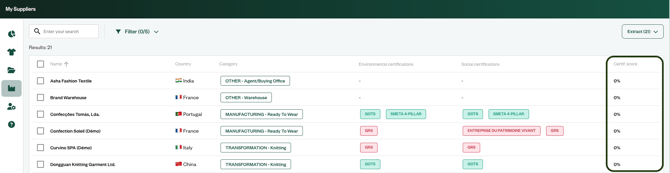
For each assessed pillar:
- If at least one fundamental criterion (a criterion considered too important not to be met—e.g. prohibition of forced labor) scores 0, then the pillar receives 0%.
- Otherwise, the pillar's score is the average of the scores of its criteria, multiplied by 100 (result in percentage).
The final certification score is the average of all the pillar scores, visible in the App at the supplier profile level.
Overall certification score (collection page):
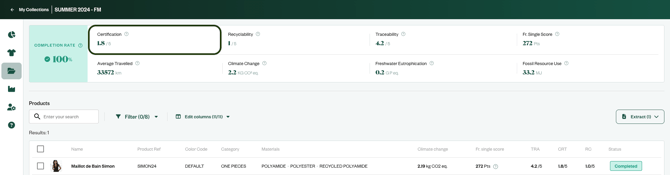
For each criterion, the highest score is retained.
- If a fundamental criterion scores 0, the corresponding pillar also receives 0%.
- Otherwise, the pillar receives a score based on the average of the criteria scores, multiplied by 100.
The final certification score is the average of all pillar scores, standardized on a scale of 5.
Use of the Score
A decision-making tool
These scores are intended for internal use only and do not appear on product pages. They offer a first assessment of suppliers’ social compliance and help you identify higher-risk suppliers to guide your audit efforts.
Top 3 of certification scores :
1. CMIA - 68.98%
2. GOTS - 64,1%
3. FAIRTRADE TEXTILE STANDARD - TRADER - 37.4%